Who Owns the Next Hill?
When to leave a winning hill, what to carry, and whose legs you are standing on.
6 min readThe view from the top
Every company that has ever won has stood, for a while, on top of a hill. The view is wonderful. It is also the most dangerous view in business, because the hill you stand on is the one thing you cannot see past.
Success offers money, knowledge and room to experiment. It also offers a convincing reason to stay.
AI has made staying expensive. This is the Game of Thrones phase of a technology: alliances form in the morning and dissolve by dinner, suppliers become rivals, and partners build alternatives to each other’s products. A company can climb quickly and discover that somebody else owns the path, the equipment and the gate at the top.
So the question is not only which hill comes next. It is when to leave this one, what to carry, and whose help you will need on the way.
Twelve climbs, four outcomes
We looked at a dozen climbs, old and new. They suggest patterns, not laws.
| Company | The climb | What it shows |
|---|---|---|
| Netflix | DVDs → streaming | Start before the old business disappears |
| Apple | iPod → iPhone | Accept cannibalisation |
| Nvidia | Graphics → accelerated computing | Existing capabilities can open larger markets |
| Adobe | Licences → subscriptions | Accept disruption to reported results |
| Amazon | Retail → AWS | An internal problem can reveal an external market |
| Microsoft | Windows and Office → cloud | Renew before decline consumes the company |
| Reliance | Refining → Jio | A cash engine can support a distant bet |
| Fujifilm | Film → healthcare and materials | Carry expertise beyond its original product |
| Intel | Memory → microprocessors | Retreat can release the next business |
| Kodak | Film → digital | Seeing the future does not secure its economics |
| Nokia | Industry → phones → smartphones | One successful transition guarantees no second |
| GE | Industry → sprawling finance | Expansion can import risks the core cannot carry |
Four patterns recur: moving while strong, moving under pressure, failing to build a successor that pays, and overreaching.
Netflix and Adobe changed how customers bought while their existing businesses still worked. Intel and Fujifilm moved under far more urgent pressure. Kodak pursued digital, but could never make it pay the way film did. GE shows the opposite danger: the next business can threaten the one funding it.
Nokia belongs in two stories. It became a formidable phone company, then stumbled at the next transition. The habit of leaving must outlive the leaders who first learned it.
Four kinds of climbers
Timing matters. So does style. Two questions sort every climber: how many bets is it making, and how far from home are they?
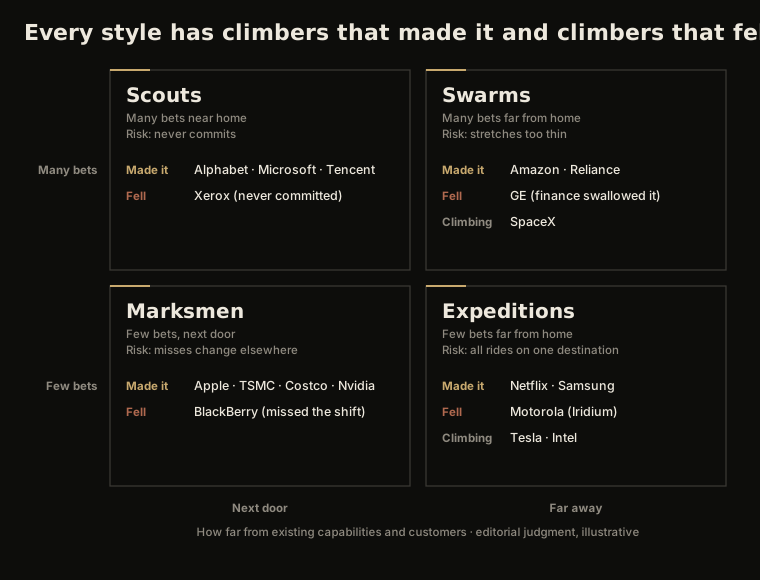
No style wins by itself. Every quadrant holds climbers that made it and climbers that fell, and each style works only when it fits the base camp and the cash behind it. The placements describe a company’s dominant climb, not a permanent personality: Microsoft scouts widely, but almost always inside computing. Nearby is not the same as easy.
Most great companies are several climbers at once. Picture each as a core with bets in orbit: some close in, some far out.
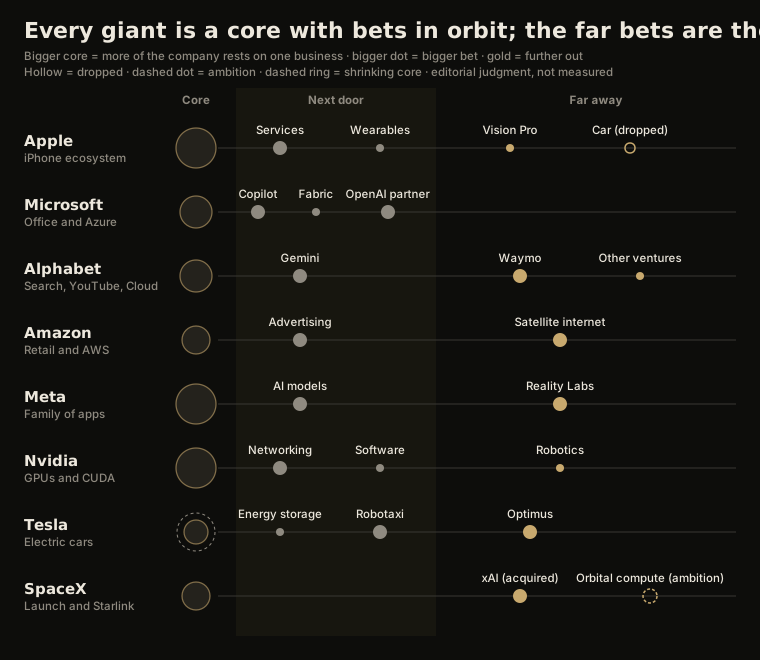
AWS and Starlink now sit inside their companies’ cores: yesterday’s leap can become tomorrow’s platform. Tesla is the live test of the opposite. Its core is shrinking, with car sales down two years running, yet it raised this year’s spending plan to about $25 billion, much of it for robots. Robotaxi sits next door; Optimus is far out. Batteries, motors and vision software may travel, but engineering resemblance is not customer acceptance. Optimus is an expedition launched from the slope, not the summit.
A good base camp is a lookout. Microsoft’s place inside enterprise work reveals problems around data and productivity. Amazon’s experience building technology services for itself helped it recognise a market for infrastructure. The best base camps sit inside the customer’s daily work. A commodity product shows you nothing but itself.
Some hills keep rising. TSMC and Nvidia have enlarged their markets with capabilities they already had. The point is not to leave by reflex, but to notice when renewal needs a new direction. Kodak’s hill was sinking. TSMC’s still isn’t.
Scout wide, then climb narrow. Exploration needs variety; commitment needs concentration. Confusing the two produces either endless experiments or a beautifully executed climb to the wrong summit.
What strategists and soldiers knew
None of this is new. Strategy has circled the next hill for decades, and soldiers for millennia.
| Lens | Question for the climb |
|---|---|
| Porter: competitive forces | Who can take the profit from this position? |
| Christensen: jobs to be done | What human need survives this product? |
| Prahalad and Hamel: core competence | Which abilities travel with us? |
| Boyd: orientation | What has success trained us not to see? |
| Clausewitz: culmination | When does advancing leave us weaker? |
| Machiavelli: borrowed arms | Whose strength are we relying on? |
Boyd is remembered for speed, but his deeper point was orientation. We see the world through our experience and our past wins. A film company could recognise the digital camera and still be unable to imagine prosperity without film.
Machiavelli asks the uncomfortable question for AI. Your model may depend on someone else’s chips, cloud, distribution or permission. Partnership can make the climb possible; dependence can hand the partner power over its rewards. The question in our title is really his: who owns the hill you are about to stand on?
Every next hill begins with a walk downhill
Here is the thing no map shows. Between two summits lies a valley. Crossing it means surrendering margins, certainty, status and the applause attached to yesterday’s success.
That is why leaving is hard. The people resisting change are often protecting something they built well, for customers they understand. Nobody wants to walk downhill while the crowd is still cheering.
Adobe’s subscription move disturbed its familiar revenue for a while. Netflix’s move beyond DVDs included painful missteps. Every summit-leaver paid for the valley; they simply paid while they were strong.
So the choice is never whether to walk downhill. Time and rivals will see to that. The choice is whether you take that walk while you are strong, or get pushed down it when you are weak.
Anyone who has left a good job for a better life knows the feeling. You do not yet have the future you are choosing, and you are giving up something real. Today’s profits can buy time to learn. They cannot buy certainty. Wait until they fade, and you start the walk with an empty pack.
What makes the walk bearable is knowing the need outlasts the product. People still keep their memories. They just stopped using film to do it.
So who owns the next hill? Nobody yet. It belongs to whoever is willing to walk down from this one, with enough strength left to climb the other side.
What to look for in a climber
Whether you run the company or own its shares, four questions do most of the work:
- Is the hill still rising, or am I already on the slope?
- What can I see from here, and what will I carry?
- Who pays for the climb, and could they stop?
- What is the price already assuming?
They will not hand you a verdict. They tell you which question decides it, and a different one bites for each company.
In calm times, the highest hill wins. In turbulent times like these, when thrones change hands each season, the winner is the climber who keeps the habit of leaving. Do not demand certainty from the new business while quietly assuming permanence in the old one.
The hill was never the point. The climber is.
Analysis and education, not investment advice.
Amazon, “Andy Jassy’s 2023 letter to shareholders” (origins of AWS): aboutamazon.com
Kodak, photography history: kodak.com
Bloomberg via Claims Journal, “Tesla Plots $20 Billion Splurge to Support Musk’s AI Future,” 29 January 2026: claimsjournal.com
The Next Web, “Tesla raises 2026 capex to $25 billion,” April 2026: thenextweb.com
Fortune, “Elon Musk’s SpaceX buys xAI in stunning deal valued at $1.25 trillion,” 2 February 2026: fortune.com
SpaceX, updates on the xAI acquisition and orbital compute: spacex.com