The Hill Beyond the Hill
How climbing changes what we can see — and what becomes possible next.
5 min readImagine a software company whose renewal rates are rising. Support costs are falling. New features arrive faster than ever. Its AI programme appears to be working.
And it probably is.
But suppose some customers are beginning to accomplish the same work without opening its software. The company’s performance is improving, even as the value of its product may be changing.
There is nothing false about the hill it has climbed. It may have been enormously profitable, and may remain so for years. The question is whether the company can see what lies beyond it.
Satya Nadella has spoken of building a hill-climbing machine: an organisation that learns continuously from experiments and results. In an earlier essay, The Machine Climbs. The Investor Leaps., we considered what such machines might mean for investors.
There is another possibility worth exploring. Climbing does more than bring us closer to an objective. It changes what we are capable of attempting.
Along the way, we acquire tools, knowledge and judgment. Problems that once consumed our attention become routine. From higher ground, we can see opportunities that were invisible below.
The next hill may be an extension of the first, a better route through familiar territory, or something entirely new. The achievement of one climb enlarges the possibilities of the next.
Four kinds of hill
Not every climb should be approached in the same way.
Before assigning work to an intelligent machine, two questions matter: how clearly can we tell whether it has succeeded, and how costly is a mistake?
Those questions produce four useful conditions.
Paved hills have clear feedback and recoverable errors. Software testing, routine reconciliation and repetitive processes often belong here. Automate the work, measure the results and intervene when performance drifts. Human attention can move elsewhere.
Accountable hills also have relatively clear feedback, but mistakes carry consequences. Financial transactions, underwriting and regulated approvals demand limits, independent checks and records of what happened. Machines can do much of the work, but responsibility cannot simply be delegated away.
Creative hills allow cheap experiments, yet success is difficult to define in advance. Design, new products and early ideas benefit from variation, criticism and contact with real people. The machine can help us explore widely; judgment determines what is worth pursuing.
Strategic hills combine uncertain feedback with costly commitments. Entering a market, acquiring a company or rebuilding a business model may take years to evaluate. Here the sensible approach is to test assumptions, preserve options and commit in stages.
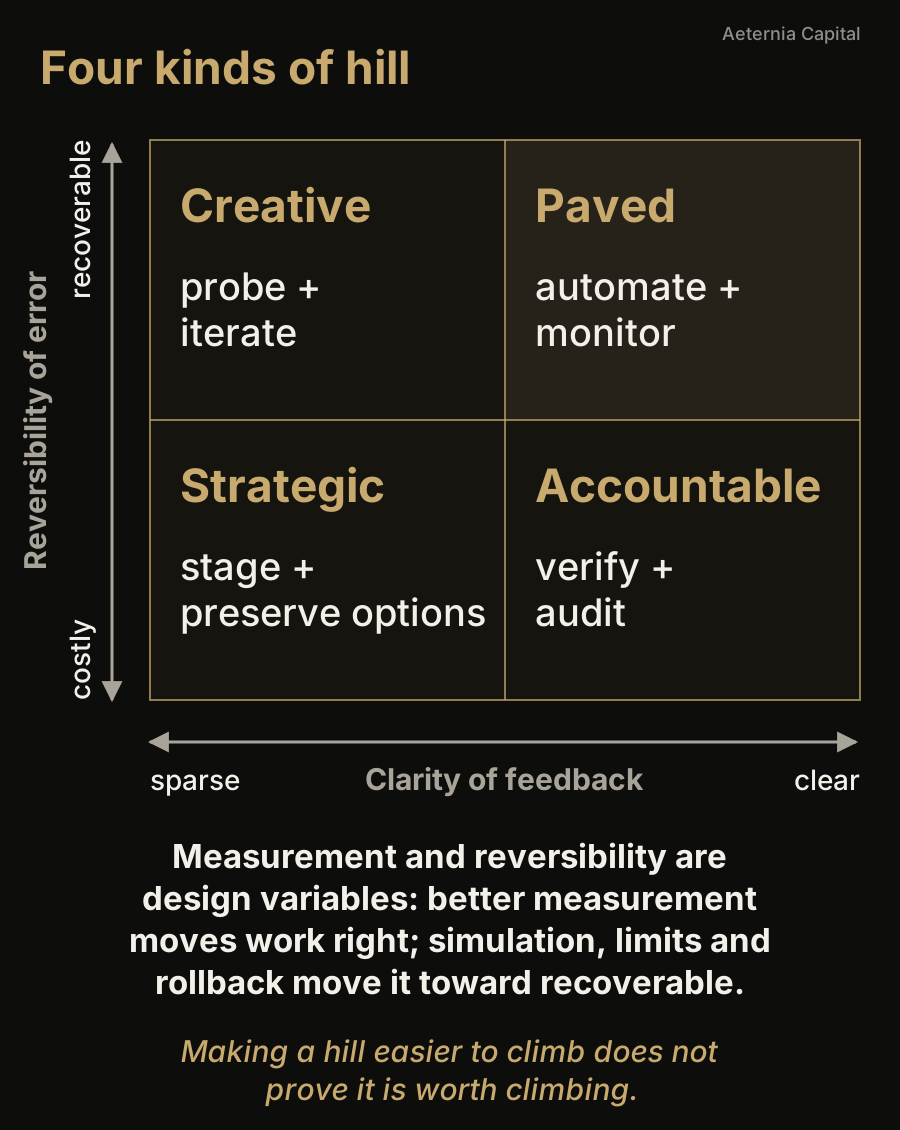
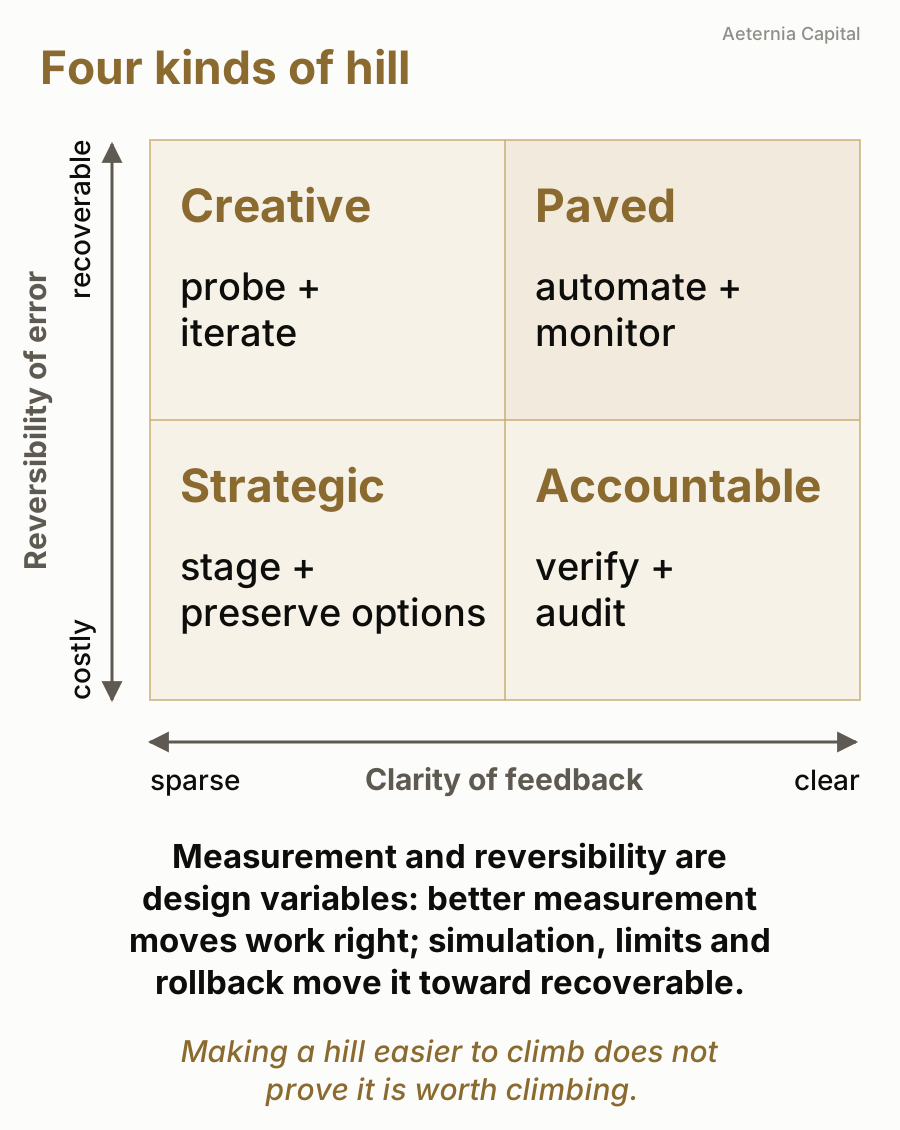
These are not permanent categories. A difficult process can become easier to measure. Simulation, safeguards and rollback can make mistakes less expensive. What begins as a Strategic or Accountable hill may, through investment and learning, become safe enough to pave.
That is one of AI’s most useful possibilities: not merely climbing faster, but changing the conditions of the climb.
It also creates a danger. Once we have made a process wonderfully efficient, we may become reluctant to question why we are doing it.
What success can conceal
Organisations are understandably drawn to work they can measure. A machine that improves conversion, reduces costs or accelerates delivery produces evidence of progress every day.
Evidence that the business itself needs to change is harder to obtain.
James March described the tension between exploiting what we already know and exploring what we do not. Donald Sull showed how organisations can remain intensely active while trapped in the habits that once made them successful.
AI does not create that problem. It can make it more seductive.
Consider Microsoft’s efforts to bring Office capabilities into Copilot while also bringing Copilot into Office. One interpretation is that Microsoft is preparing for a world in which people still need to accomplish the same work but may no longer want to interact with software in the same way.
Whether that strategy succeeds remains to be seen. The important distinction is between protecting a customer’s need and protecting the current means of satisfying it.
We have encountered a smaller version of this problem in building our own investment systems. It is possible to accumulate agents, reports and increasingly elaborate dashboards without improving the decisions they are meant to support. More machinery is not necessarily more intelligence.
Yet this is only half the story.
A successful organisation may also discover new opportunities because of what it has learned. Its existing capabilities can provide the knowledge, customers and capital needed to pursue them.
The task, then, is neither to defend every existing hill nor to abandon one whenever a more fashionable mountain appears.
It is to learn when the view has changed.
The Climber and the Surveyor
The Climber improves the work before it. It measures, experiments and gradually makes difficult things routine.
But climbing alone does not tell us where to go next.
For that we need a Surveyor: a person or function able to examine the wider terrain without being rewarded solely for progress on the current hill.
The Surveyor draws on two kinds of evidence. Internal results reveal what the organisation has learned and what it can now do. External scouts watch customers, competitors, substitutes and opportunities beyond the familiar landscape.
The Surveyor’s questions are simple, though answering them may not be.
What has become possible because of our progress?
What are customers beginning to need less?
And what small experiment might change a decision we are postponing?
The last question matters most. Without a route from observation to experiment, and from experiment to a decision, the Surveyor becomes another producer of reports.
Nor should the Surveyor always recommend leaving. Sometimes the evidence will favour another decade on the same hill. Sometimes the best opportunity is just beyond its crest. Sometimes the business must make a much larger leap.
The point is to see the choices clearly enough to make them deliberately.
From summit to basecamp
The familiar picture of progress ends at the summit. We climb, arrive and celebrate.
But the summit may be more useful as a basecamp.
The machine can maintain much of what has been conquered. The knowledge acquired during the ascent becomes available for the next attempt. Human attention, no longer consumed by every step of the old climb, can turn towards problems that require imagination, judgment and courage.
This does not mean the machine can be left entirely alone. Conditions change, systems drift, and even familiar work needs oversight. Nor does it mean every newly visible hill is worth pursuing.
It means successful exploitation can make better exploration possible.
For investors, this changes the question we ask of a business. We should care not only about the strength of its present advantage, but about what that advantage enables it to learn and attempt. Does management recognise when a cherished metric is losing meaning? Can the company pursue new opportunities without casually destroying what it has already built? Does it know when to persist?
And, inevitably, how much are shareholders being asked to pay for those possibilities?
There is no formula that settles these questions. But an organisation that can climb well, learn from the ascent and recognise what lies beyond it possesses something more interesting than operational efficiency alone.
The hill was worth climbing. It may still be.
What matters is that, from the top, we can finally see further.
Analysis and education, not investment advice.
Satya Nadella on the “hill-climbing machine”, post on X, June 2026, as reported by Redmond Magazine, “Nadella Says Enterprise AI’s Future May Depend Less on Frontier Models Than Learning Systems,” 18 June 2026: redmondmag.com
Stratechery — An Interview with Microsoft CEO Satya Nadella About Finding Core Competencies, 4 June 2026: stratechery.com
James G. March, “Exploration and Exploitation in Organizational Learning,” Organization Science 2(1), 1991: doi.org
Donald N. Sull, “Why Good Companies Go Bad,” Harvard Business Review, July–August 1999: hbr.org
The Official Microsoft Blog — Introducing the new Copilot with Home, Code and Autopilot (Office in Copilot), 25 September 2026: blogs.microsoft.com