Right about the wave, wrong about the boat
Being early can look exactly like being wrong. On leverage, value migration, and why the believers who finance a revolution rarely keep it.
8 min readOn July 24, Leopold Aschenbrenner told investors that the selloff in AI stocks had created some of the best buying opportunities in more than a year — and invited them to send more money.
Six days later, his fund had lost 67% for the month. In a subsequent investor letter, he reportedly wrote that it had come closer to permanent capital impairment than was acceptable. Situational Awareness then exited its public-equities portfolio in a block sale to Citadel.
He may still be right about AI.
His portfolio was built so that being early looked exactly like being wrong.
That is the real lesson of the blowup. The most dangerous way to invest in a technological revolution is to own the capacity everyone must build, short the businesses that can rent it cheaply, and finance the spread with leverage.
The tape convicted the portfolio — not necessarily the thesis
Few investors expressed the AI thesis more completely than Aschenbrenner. He owned the physical buildout — the memory, power, chips and rented compute — and shorted software companies he expected AI to destroy. Leverage amplified both views.
Then both sides moved against him.
The capital-hungry infrastructure companies he owned fell sharply. The enterprise software companies he was short rose. This was not a broad market collapse. It was a repricing of almost precisely the spread his portfolio was designed to express.
But one month of price action cannot settle a decade-long argument. Markets rotate. Crowded positions unwind. Forced sellers can help create the prices later cited as evidence against them.
July proved something narrower — and more important.
The portfolio could not survive the market disagreeing with it for one month.
Leverage determines how fast you lose, not whether the underlying idea is ultimately right. A ten-year thesis financed in a way that must be vindicated every month is not really a ten-year position. It is a sequence of short-term solvency tests wearing a long-term story.
The believers build it. Someone else keeps it.
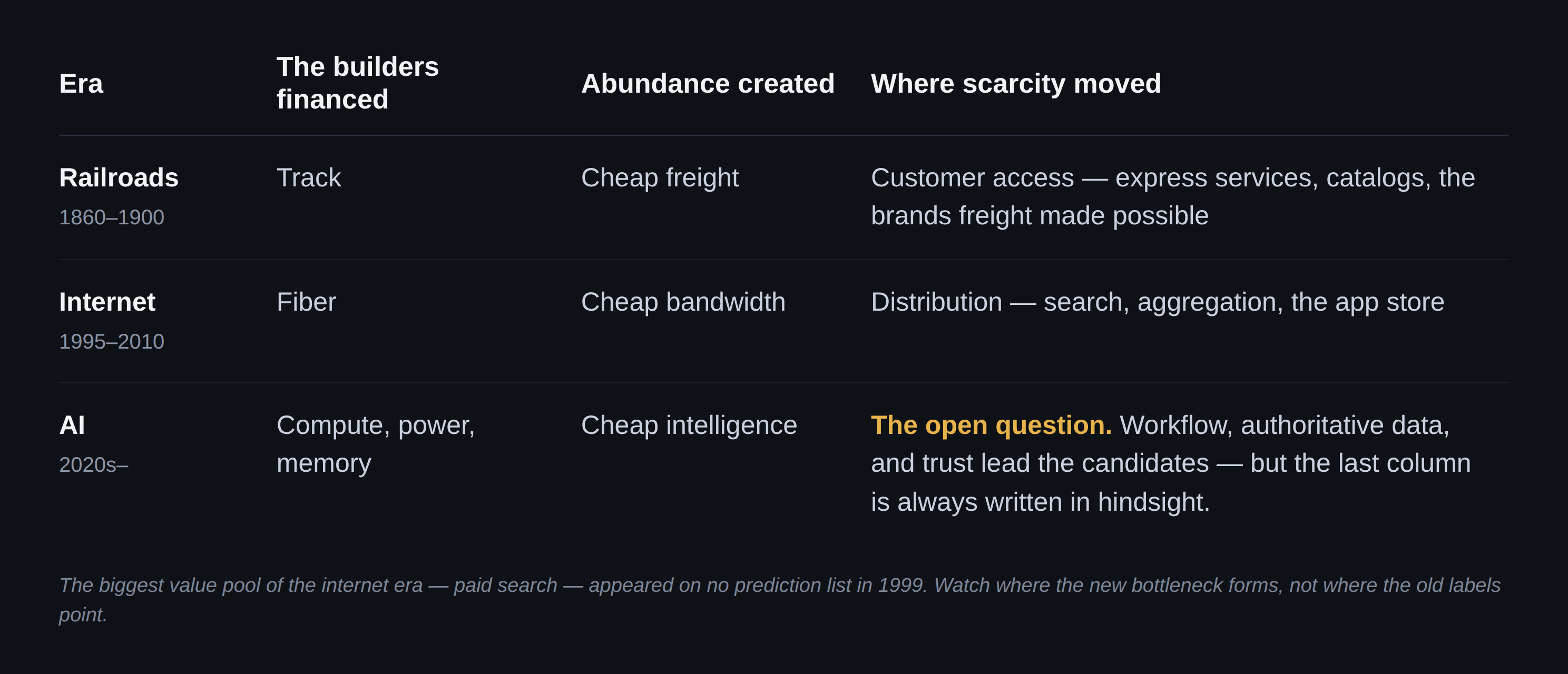
Between 1860 and 1900, railroads were among the most important technologies on earth. The men who believed in them financed thousands of miles of track — and went bankrupt in waves, including the panics of 1873 and 1893, while the network kept expanding.
The technology succeeded. Many of its financiers did not.
Every additional mile made the network more valuable to the country. But overbuilding and competition pushed freight rates down, making the economics more difficult for the companies that had paid for the rails.
Meanwhile, Adams Express bought space on other companies’ trains and moved parcels and money across the network. It did not need to finance the tracks beneath it. Pullman used a similar model, leasing sleeping cars to railroads rather than building an entire rail network.
They owned services and customer relationships on top of infrastructure that other people had paid to construct.
Adams Express eventually stopped being an express operator and became a closed-end investment fund in 1929. Its corporate descendant still trades today. The historical continuity is a curiosity; the business-model distinction is the point.
The pattern repeated during the fiber boom.
Telecom companies spent fortunes laying the glass the internet would need. Global Crossing built a network spanning more than 100,000 miles, then filed for bankruptcy under more than $12 billion of debt. The fiber did not disappear. It became cheaper capacity for the businesses built on top of it.
The internet delivered what its builders had promised. Much of the value accrued elsewhere — to businesses that could rent abundant bandwidth, own the customer and scale without recreating the network.
In every buildout, capacity is the part everyone can see. So capacity is where the believers’ capital crowds in. Then the buildout succeeds, supply arrives, and the scarce resource moves somewhere else.
The builders finance the wave. The riders compete to harvest it.
The layer he shorted may be the layer cheap compute rewards
Aschenbrenner’s deeper bet was not merely that AI infrastructure would boom. It was that AI would dissolve today’s software incumbents.
That may prove true for some of them. But cheap intelligence is not automatically a threat to the software layer above it. It can also be a historic reduction in that layer’s cost of production.
Enterprise software is often described as code. That misses what the strongest vendors actually sell.
They sell the system of record a company cannot turn off. The audit trail a regulator may inspect. The workflow around which employees, permissions and data have accumulated. They sell distribution, trust and the institutional scar tissue created by years of integration.
A model may reproduce a feature. It does not automatically reproduce the right to become authoritative inside a large organization.
For the best-positioned incumbents, cheaper compute means more intelligence can be embedded inside products customers already use. AI becomes an upsell, a consumption stream or a reason to deepen the workflow — not necessarily a replacement for it.
But “software wins” is not the same as “every software incumbent wins.”
Some products are little more than replaceable features bundled behind a seat license. And the seat model has a hard question coming for it: the technology vendors are selling promises to do work that employees used to do. A company whose revenue is a headcount tax is exposed to the very productivity it is marketing.
The toll booth may survive while the basis for charging the toll changes.
One caution before the checklist
The specific pool where value collects has been unforeseeable in every wave. Nobody watching the railroads fail predicted the mail-order catalog. Nobody in 1999 predicted that the internet’s single largest fortune would be paid search — it appeared on no forecast list of the era. If I told you with certainty that this wave’s value lands in “workflow and proprietary data,” I would be making Aschenbrenner’s mistake with more fashionable nouns.
What history does repeat, reliably, is the shape: value migrates to whatever remains scarce once the wave’s core resource becomes abundant. Cheap freight made customer access scarce. Cheap bandwidth made distribution scarce. Cheap intelligence will make something scarce — trust, perhaps, or the authoritative record, or the surface where work already lives, or a physical bottleneck like connected power that no amount of capital can quickly replicate. Or something none of us have named yet. You don’t need to guess the address in advance. You need a way to recognize it when it forms — and the tell is always the same: the new scarcity is wherever prices can rise without customers leaving.
Value migration
Do not ask “hardware or software?”
Ask who controls the scarce resource after compute becomes abundant.
For every company you own — or work for — ask five questions:
- Does it own the authoritative data or system of record?
- Does it control distribution or the customer relationship?
- Can it move from seat pricing to usage, transaction or outcome pricing?
- Does cheaper intelligence improve its margins and product — or erase its differentiation?
- Can it raise the toll without making replacement economically rational?
If a software company passes those tests, AI may send more traffic through its booth.
If it passes none of them, “recurring revenue” may simply mean recurring revenue until the next procurement cycle.
This is why sector labels are so dangerous. “AI infrastructure” can contain both a scarce monopoly and tomorrow’s commodity capacity. “Enterprise software” can contain both an irreplaceable system of record and a feature waiting to be generated.
The question is not which layer sounds closest to the future. It is where pricing power remains after the future arrives.
Conviction is fuel, not a strategy
Aschenbrenner’s decade thesis may yet prove right. The private AI investments the fund retained may eventually vindicate much of it.
But markets do not pay you merely for being right. They pay you for being right with a structure that survives the interval.
Great technologies routinely destroy some of the people who finance their arrival. Railroads did it. Fiber did it. AI may do it again.
The winning investor is not necessarily the one who believes first or loudest. It is the one who identifies where scarcity — and therefore pricing power — will remain after capacity becomes abundant, then builds a position capable of staying alive long enough to collect.
Conviction is fuel. Structure is what keeps it from becoming a fire.
The wave does not care who loved it first. Build a boat that is still afloat when the wave arrives.
I invest for a living and write about how bets survive their own timelines. This is a framework, not a recommendation. Your decisions, as ever, are yours.
Axios — Situational Awareness sold its public-equities portfolio to Citadel: axios.com
CNBC — Situational Awareness faced steep losses during the AI selloff: cnbc.com
SEC correspondence describing Adams Express’s 1929 transition from express company to closed-end fund: sec.gov
National Park Service — Pullman’s leasing model: nps.gov
CBS News — Global Crossing’s road to ruin: cbsnews.com
This essay is one of a pair on concentration and structure. Its companion, The Unchosen Bet, follows next week.
Related reading